Old Wilsonian delivers Maths Circle Lecture #2
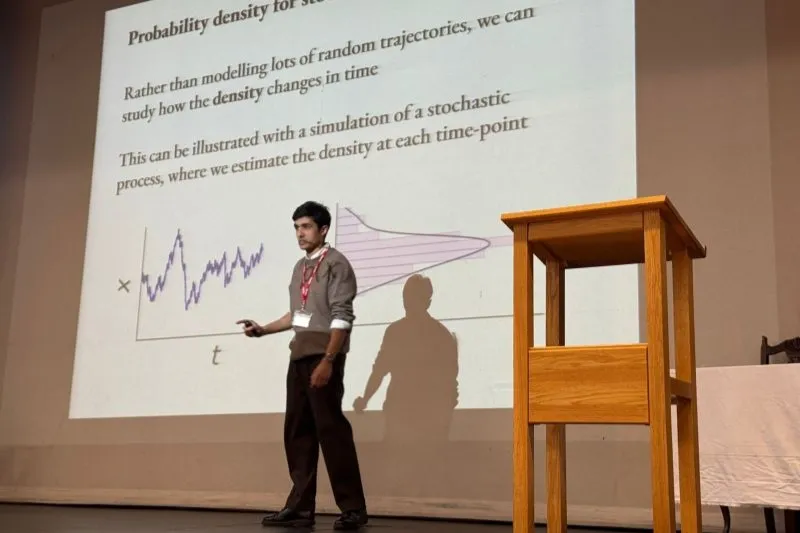
Wilson’s School welcomed back alumnus Ramón Nartallo-Kaluarachchi (Class of 2018) for the second of three expert lectures on stochastic processes. Ramón, currently a researcher at the University of Oxford, recently received the Graham Hoare Prize from the Institute of Mathematics and its Applications (IMA) for his Mathematics Today article about 'Mathematic Memory Machines'.
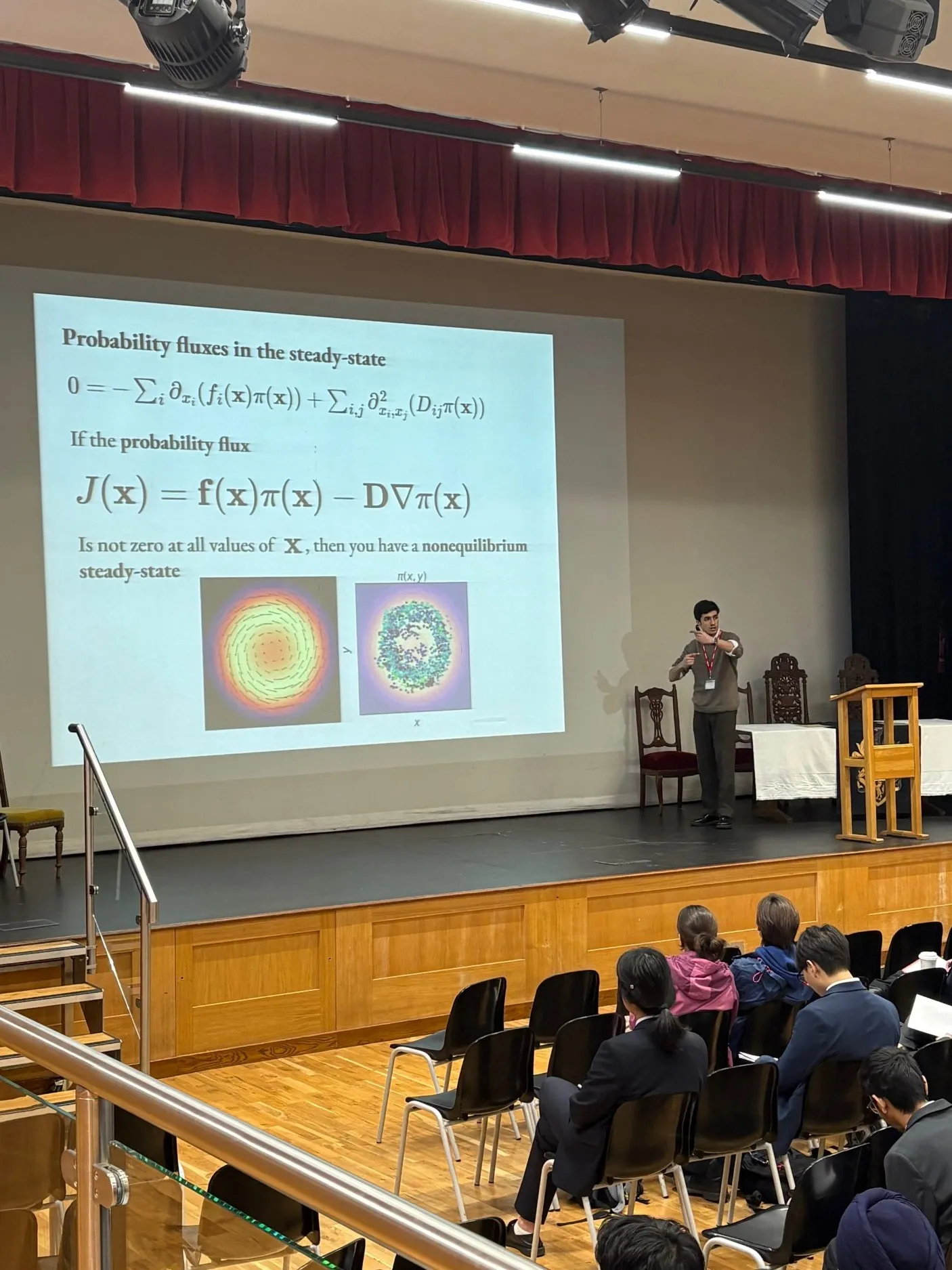
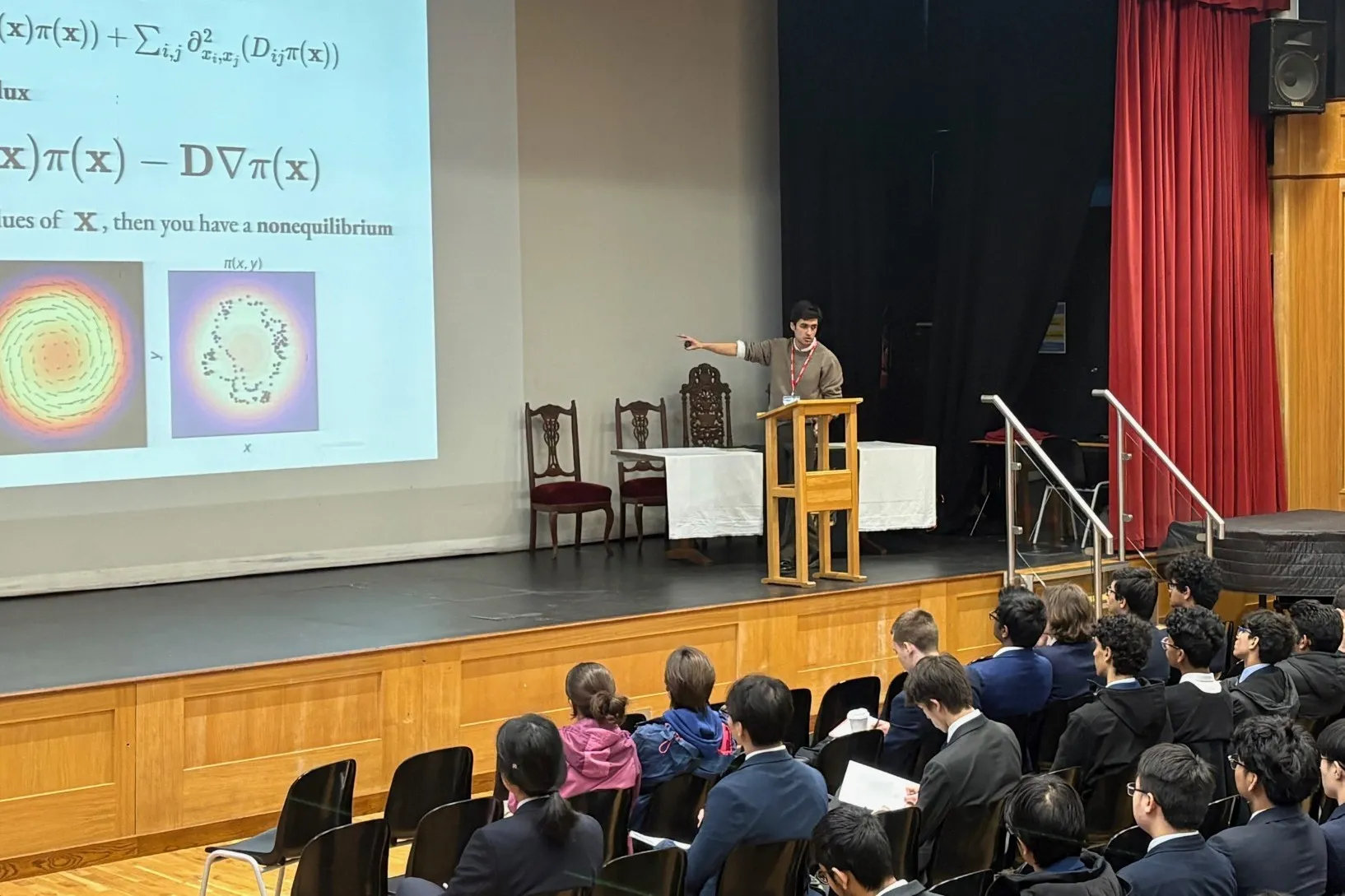
In this talk, titled Time’s Arrow: Life out of equilibrium, it was explained that living organisms like me and you, don't devolve into a state of maximum entropy (where the energy of a system is uniform and at maximal disorder), as they are in a non-equilibrium steady state (NESS), by actively dissipating heat.
By modelling these complex biological phenomena, Ramón used stochastic dynamical systems. These represent the state of a system changing over time via differential equations, but with added "noise" or randomness (known as a Wiener process). By calculating the probability flux—the flow of probability within the system—and the Entropy Production Rate (EPR), researchers can distinguish between more active or passive processes.
Though this principle is mainly used in thermodynamics, mapping have many useful biological applications , from distinguishing between healthy and dysfunctional red blood cells, to modelling the amount of cancerous mutations, to even mapping out neural manifolds to study how associative memory works - Ramon used pattern recognition to generate a final image from randomness by using the master equation (measuring net movement of nodes in a particular direction).
We are immensely grateful to Ramón Nartallo-Kaluarachchi for coming back to Wilson's to inspire the next generation of mathematicians and scientists. By sharing his latest research with our Year 11s and Sixth Formers—as well as the thousands of others who have engaged with his work online—Ramón demonstrated the real-world power of the subject. His lecture provided a brilliant example of how abstract mathematics is the key to unlocking the mysteries of how we live, think, and remember.
Ramón Nartallo-Kaluarachchi's article can be accessed here.
Article written by Isaak (Year 12)